The craft
How a Sicilian puppet is built, dressed and worked on stage
Who makes a pupo, what makes the Palermo type distinct and how a puppeteer controls the sword, from UNESCO and Wikipedia.
Book the puppets ↗Quick answer
UNESCO says craftspeople using traditional methods carve, paint and build the puppets, often within family-run companies. Wikipedia adds that puppeteers frequently build their own figures and paint scenery and posters, and that the word puparo originally meant the puppet maker. A Palermo puppet stands about 90 cm, has articulated knees and carries a sword worked by a wire through the right hand.
Who makes the puppets
UNESCO's listing says the theatres were often family-run businesses and that craftspeople using traditional methods carved, painted and built the puppets. Wikipedia says puppeteers often built their own puppets, painted scenes and made posters, and that the term puparo originally referred to the puppet maker. The maker and the performer were often the same person, which is why a company's figures share a style.
What the figure looks like
The puppets were renowned for their intense expressions, says UNESCO. Wikipedia says Christian heroes have gentle faces and family emblems, while Saracens have sharper features, turbans and half-moon and star motifs. The costume is therefore a code as well as a decoration: faces, emblems and armour tell the audience whose side a figure is on.
Body and joints
Palermo puppets are about 90 cm and 5 to 10 kg, with articulated knees, according to Wikipedia. Catania puppets are taller and heavier and have legs without articulated knees. The knee joint matters for movement: it lets a Palermo figure step and bend with more ease.
Working the sword
Wikipedia explains that in Palermo the sword is drawn and sheathed by a wire through the right hand. The figure's body is supported and moved by the puppeteer from the wings at stage level. The Palermo stage is deeper than it is wide, because the puppeteers move around its sides. Catania puppeteers stand on a bridge behind the scenery instead.
Sets, posters and painted scenes
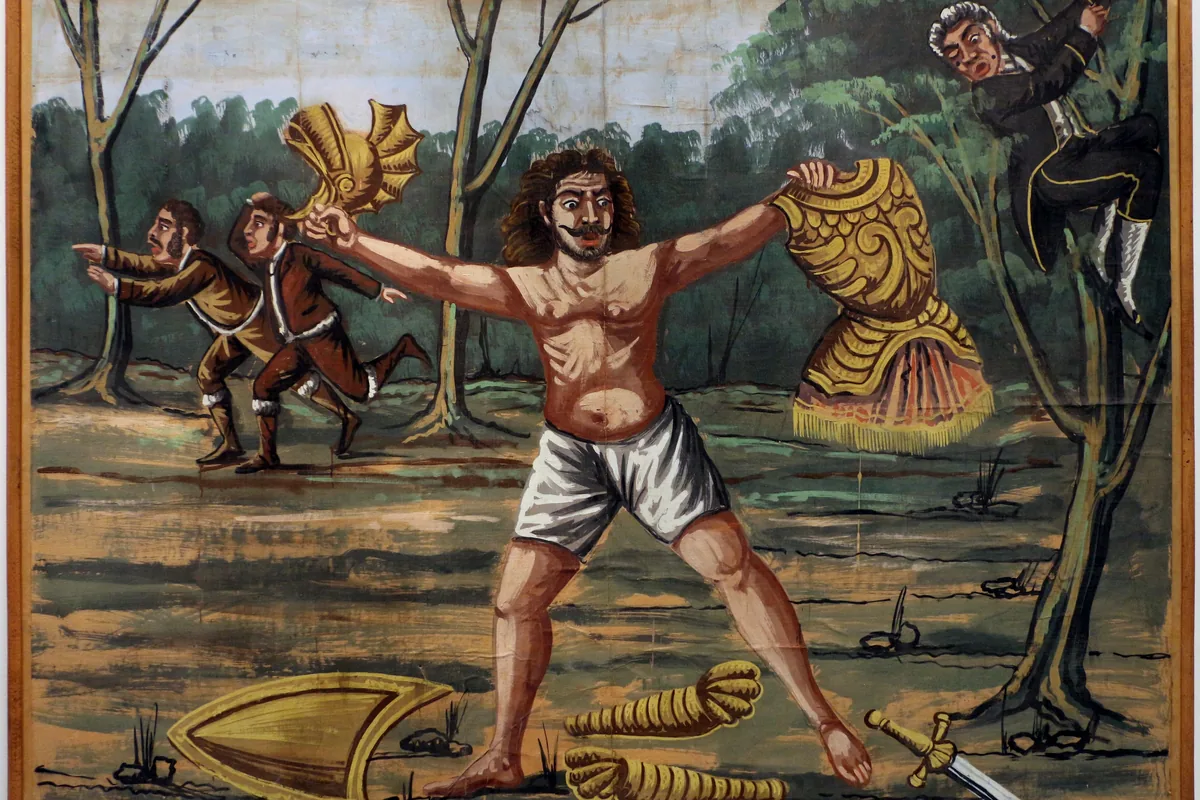
UNESCO mentions colourful stage backdrops as part of what distinguishes the schools. Puppeteers also painted scenery and made posters, per Wikipedia. A painted poster shows the episode of the night, and a surviving Commons photograph shows one with the madness of Orlando, dated before 1911.
A puppet in a museum
Palermo's Pasqualino puppet museum holds over 5,000 items, per Wikipedia, among them its oldest Palermo-school puppet, Carinda, dated 1828. In a museum you can study the armour up close; at a show you watch it move. Each gives something the other cannot. For a single choice, the show is where you see the craft at work, with puppeteer, set and story together.
Who this guide is not for
If you want to build a puppet yourself, this is not a workshop guide: it describes what the sources say, not how to make one. Dimensions are typical, and companies differ. If you only want the show, the plot and the dialect are the things to prepare for.
Frequently asked questions
What is a puparo?
Wikipedia says the term originally referred to the puppet maker.
Do puppeteers make their own puppets?
Often, says Wikipedia, along with painting scenes and making posters.
How is the sword worked?
In Palermo, by a wire through the right hand, says Wikipedia.
Sources